

Consistent Report Structure
Capture the same core categories for each review.
- Target address or transaction hash
- Selected network
- Risk level and indicators
- Generation timestamp
Farona Solutions
Generate structured, time-stamped reports that document the wallet or transaction reviewed, the available risk signals, and the evidence considered at that moment.
For compliance, risk, operations, audit, treasury, and case-review teams that need consistent documentation of blockchain risk checks.
Why this matters
Screenshots, copied scores, and informal notes can leave important questions unanswered. A consistent report helps show what was checked, when it was checked, and which indicators were available.

Core capabilities
Capture the same core categories for each review.
Document more than a headline score.
Preserve relevant address and transaction context.
Keep reports available for future internal reference where enabled.
Use cases
Attach a blockchain risk report to an internal onboarding or enhanced-review file.
Document the evidence reviewed when a transaction requires escalation.
Record the available risk context before approving a new crypto counterparty.
Generate a new time-stamped report when reassessing a previously reviewed wallet.
Use consistent reports to support internal reconstruction of prior review activity.
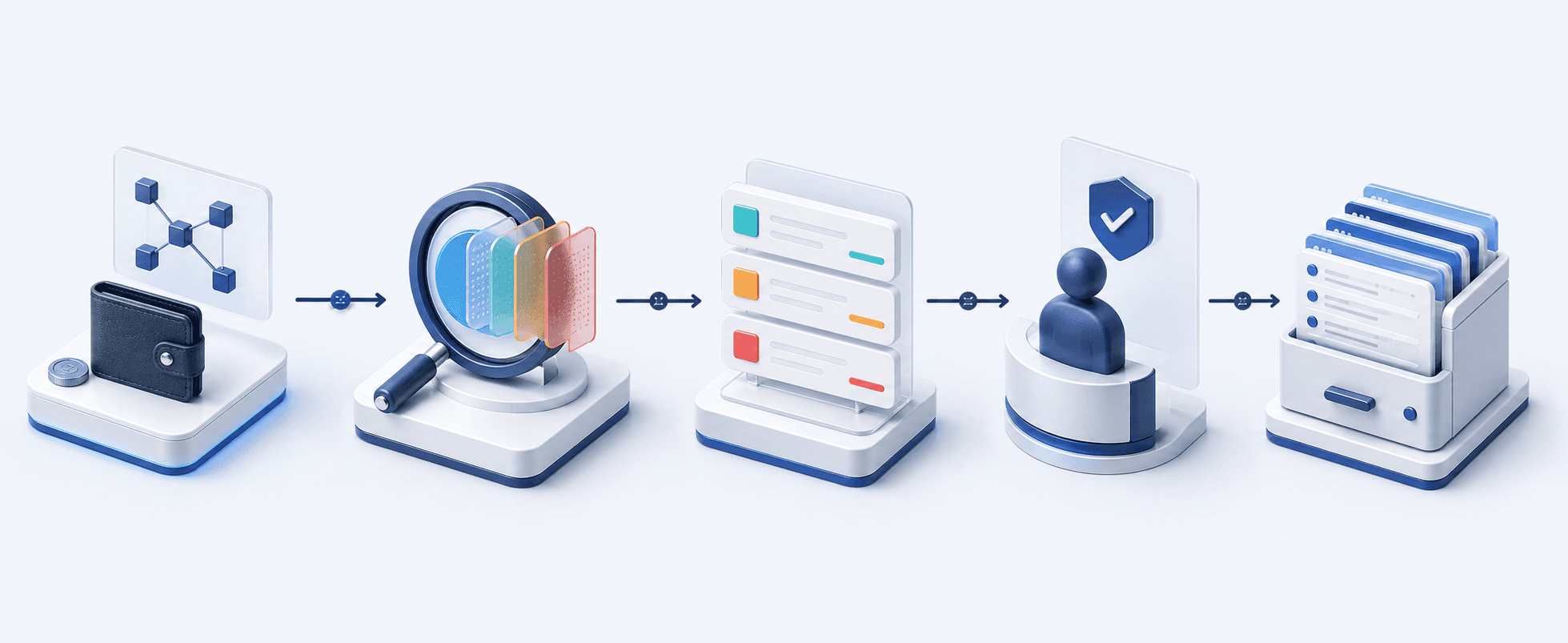
Workflow
Identify the wallet or transaction requiring review.
Generate a report using the relevant supported network.
Review the result and add your organization’s decision, rationale, and reviewer details in its own system.
Retain the Farona report according to your internal record-retention policy.
Farona reports reflect blockchain intelligence and other information available when a report is generated. A low-risk result does not guarantee that an address is safe, and a higher-risk result does not independently establish unlawful activity. Reports support informed review but do not replace appropriate due diligence, professional judgment, or applicable legal and regulatory obligations.
Farona reports are informational and do not constitute legal, regulatory, tax, financial, or investment advice.
FAQ
No. It is an informational risk report, not a suspicious-activity report or filing submitted to an authority.
No. It documents available analysis; compliance depends on your complete policies, procedures, decisions, and obligations.
Yes. Blockchain activity and intelligence data evolve, so a later report may differ.
Consider recording reviewer identity, decision, rationale, escalation, supporting documents, and applicable policy references in your own system.
Availability depends on the Farona plan and enabled product features; published copy must reflect the live product.
Generate structured, time-stamped reports that document the wallet or transaction reviewed, the available risk signals, and the evidence considered at that moment.